
Capturing a crocodile jump is one of the most enjoyable yet difficult activities on your Jumping Crocodile tour, which requires appropriate preparation, accuracy techniques and good knowledge of the animal and the camera in use. In reality, Most species of crocs, particularly the saltwater variety seen in regions like the Adelaide River, have people trouble dealing with when it comes to taking pictures because of their extraordinary leaps and the sometimes erratic nature of their behaviour. This article discusses some of the most simple but very effective photographing techniques that will enable you to get sharp images portraying the grandeur of these creatures.
Understanding Crocodile Behaviour

If you plan to take photos of crocodiles jumping out of the water for you, it is first important that you comprehend their behaviour and how they live. They hunt prey by jumping, which is the case with almost all predators. If you are able to study how they act as well as which situations occasion their jumps, your chances of getting such an impressive action photograph will greatly incline towards the higher side.
Recognizing Jumping Patterns
Jumps are typically made by crocodiles out of the water for the purposes of catching prey or responding to other stimuli in the environment. Clear attempts are made during feeding or when hunger levels are scrutinized to examine for ways to make an impact, which mostly takes place in the evening or early morning, especially at dawn. Taking in these patterns helps you know when a croc is likely to be up and making a move.
Feeding Times: It has been noticed that more crocodiles are likely to jump while feeding, especially near human interference, for example, in areas targeted for tourism along the Adelaide River.
Environmental Cues: In addition, it may also affect their buoyancy and hence prompt a crocodile jump into or out of water as changes in water level, like rising or lowering, usually do. You can currently use these environmental consideration factors for estimating when it is time to get your camera ready for action.
Preparing for the Shoot

And before you even think about pushing the shutter button, make sure that you are adequately prepared. It includes the selection of the right equipment, the specification of the camera settings, and the proper warping around yourself.
Camera Equipment: The fast shutter speed of high-speed cameras is indispensable. Digital cameras and mirrorless cameras are very useful in that they can take pictures in quick succession with great accuracy. If it is an action shot, the camera must have a high frame speed enabling the taking of several shots in rapid succession.
Lenses: Telephoto lenses should be employed to achieve close-up images and not frighten the crocodile away. It is suggested to use lenses with a focal length of more than 200 mm if you want to take vivid pictures while keeping a safe distance.
Camera Settings and Techniques
The task of shooting a crocodile just when it is about to leap out can be very involving with camera settings and techniques to be adopted. Here is an essential explaining in detail what you need to be able to capture every moment.
Shutter Speed
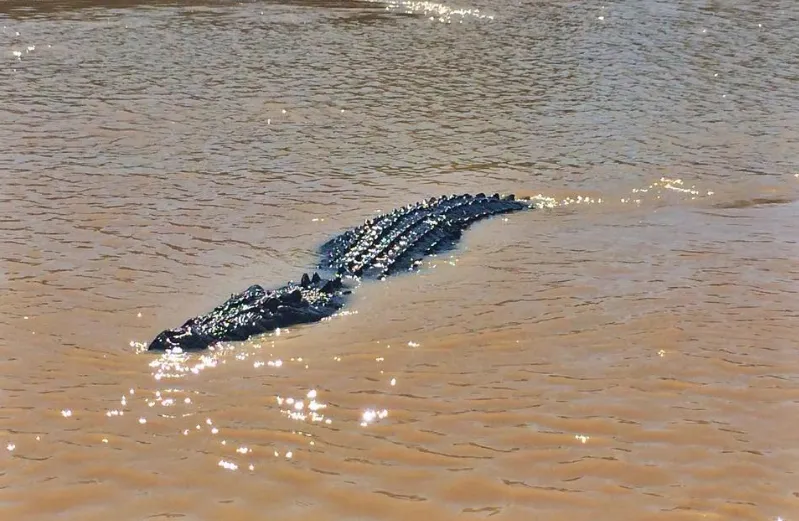
Shutter speed plays an important role in determining the quality of a photograph and, in this case, a photograph of a crocodile jumping beyond most Crocs’ reach. In this way, the details of the crocodile captured mid-air will not be blurred by speedy camera motions.
Fast Shutter Speed: Generally, shutter speeds of 1/1000 second or faster are desirable. This holds true when shooting outside on bright sunny days, as the sun’s rays may provide too much light if you haven’t set the shutter speed slow enough.
Adjusting for Light: There are moments when light is too low, such as in the morning and when the sun is being set, when you may have to change the shutter speed for proper exposure.
Shutter speed is one of the main things to watch out for from the beginning, as it ensures your pictures turn out well and are of the right clarity.
Aperture and Depth of Field
The aperture controls the focus level or depth of field of the images and the amount of light reaching the camera. In action shots which are the goal of this article, large aperture settings are usually recommended.
Widely Open Aperture or Shallow Depth of Field: To put it simply, it means opening up your aperture if it’s f/2.8 or f/4. However, this will benefit in separating the crocodile from the background in the photograph, making the animal somehow the centre of interest in your picture.
Attention and Sharpness: Wide aperture is useful in getting sharp focus on the main subject of the photograph; it helps to ensure that the main point of the picture is the crocodile.
ISO Settings
ISO settings are factors that control the amount of light sensitivity that a camera has. With regards to photography of jumping crocodiles, you will need to take into account other settings also in order to have the correct iso.
High ISO: As the light is low and fast moving subjects have to be captured, increasing iso is the only solution in order to avoid a slow shutter speed and motion blur. But high ISO should be used with care since it can possibly bring noise into your pictures.
Low ISO: On the other hand, low ISO should be used in bright days when taking pictures instead of high ISO in order to avoid overexposed pictures and maintain image integrity.
Focus and Composition

Taking a focused and clearly composed shot of a jumping crocodile requires the skill to take dynamic photographs.
Autofocus: Take advantage of the camera’s focus capabilities to center on the moving crocodile. Continuous focus mode such as AI Servo or AF-C can help to ease the process of following the crocodile as it moves and wants to keep it in the focus.
Composition: Place yourself in such a way that one can get a photograph of the crocodile jumping with a good backdrop. Do not include busy or distracting backgrounds that may take attention away from the subject.
A good focus and proper composition can help in converting an average shot into an eye-catching one.
Exposure Compensation and Lighting
Proper exposure is vital for capturing high-quality images, especially when dealing with the bright sunlight often found in crocodile habitats.
Exposure Compensation: Make sure you compensate the exposure on the camera when there are very bright areas or shiny surfaces such as on water. This can be useful in avoiding washed out highlights as well as when trying to achieve balanced exposure.
Lighting: Be careful on the light direction and strength. The sun during the early mornings or late afternoons may be helpful in providing softer light which is more favorable for your pictures.
Positioning and Safety
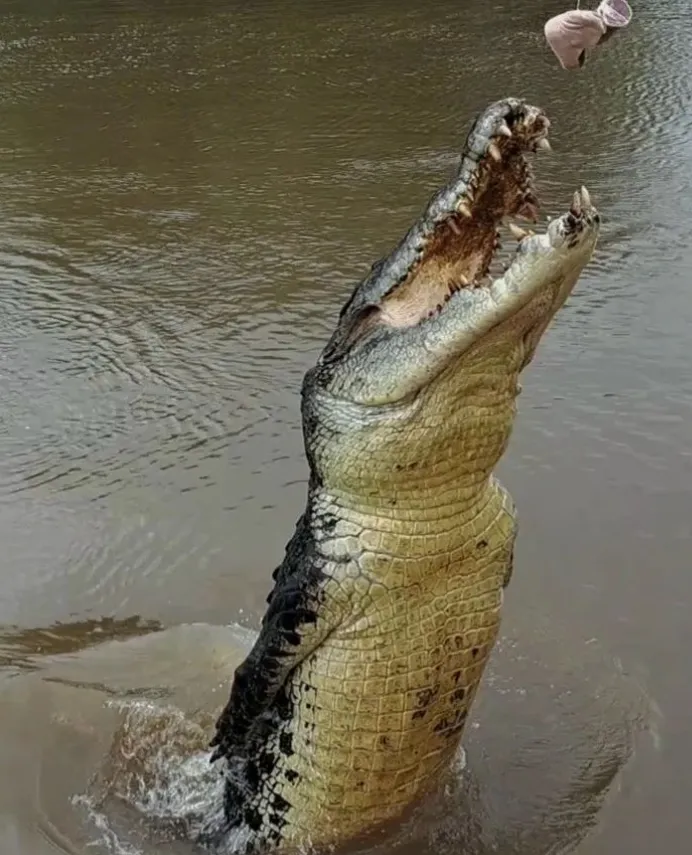
Positioning for the shot is very important not just because of the need to get the best picture but also because of the risks involved in taking pictures of wild animals such as the crocodile.
Choosing the right spot
Choose a location from which you can safely observe the crocodiles. Many photographers utilize either boats or a high-elevated structure for this.
Boats: Deadly reptiles are gotten close to using double-edge spears and encircling vessels, particularly in places like the Adelaide River. Make sure the camera is well-positioned on a stable base.
Platforms: Safety platforms or viewing decks tend to provide an edge of the crocodiles as well capturing some breathtaking movement pictures of the crocodiles.
Safety Precautions

Any time wild animals are involved remember that safety comes first no matter the circumstance. Crocodiles are wild animals as much untamed as they are highly tactical and, off the shocking scale, dangerous.
Keep Away: Make sure there is a safe distance between you and the crocodiles. Telephoto lenses are therefore favored over proximity.
Observe Rules: Obey country rules and any safety rules provided, particularly on a guided group Darwin crocodile tour or protected area.
It puts you and, most importantly, the images you are able to capture at risk because safety is required.
Conclusion
The experience of capturing the image of a jumping crocodile is both thrilling and rewarding since there is more than striking the right pose; one has to master the camera properly. A proper understanding of the crocodile’s behaviour, along with the preparation of the necessary equipment and selection of appropriate photography techniques, will enable you to significantly increase the possibility of shooting the perfect picture. Be guided by common sense and local regulations for your own safety and for the protection of the animals whose pictures you are trying to capture. Under such circumstances, it is not very difficult to achieve the effect with photographs that represent one of the most powerful and beautiful predators in nature.
FAQs
When is the most optimal time of the day to capture a jumping crocodile with a camera?
The best times are generally during the early mornings and late afternoons. These give softer light and also accommodate the crocodiles’ feeding activities.
How can I get sharper pictures without motion blur?
Use a shutter speed of 1/1000 sec or bout that much in order to freeze the motion. In addition, do not forget to raise your ISO if the situation demands.
Which lens would you recommend for distance photographs of crocodiles?
One should ideally go for a lens above 200mm, preferably termed as a telephoto lens. This means one may be far away from the subject, but vivid details can be obtained.
What should I do in order to improve the sharpness of my image?
Make sure wide apertures are employed to create a shallow depth of field but also fast shutter speeds to eliminate motion blur. Also, blurriness comes about due to inappropriate autofocus settings and shaky cameras.
How safe is it to capture images of Crocs in the rain, and what precautions would be advisable?
Make it a point to keep back; avoid being right up front, use a long lens, and don’t argue with the unsaid guidelines and norms prevailing there. Do not try to come closer to the crocodiles and never, under any circumstance, offer or attempt to feed or handle one.